1861 - 1925
Augustus Jessup's
Life and Work
|
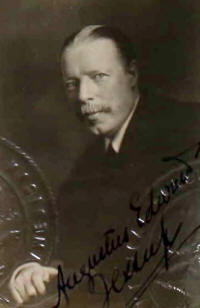
Augustus Edward Jessup
(Gus) was born in Philadelphia on June 20, 1861,
but lived most of his mature life in Europe. His grandfather, also named Augustus Edward,
was a scientist and explorer, while his
aunt, Clara Bloomfield-Moore, was an author
and friend of Robert Browning. Thus he had
both a scientific and artistic heritage.
A short history of the family and their
business, "The
Paper-Making Jessups of Augustine", can be
found in the Wilmington Morning News
(Feb.11, 1956). Gus
took no part in the business but used the
fortune he was left for travel and artistic
pursuits in Europe,
including, apparently, some
time at Oxford University,
although there is no
evidence that he graduated
[1]. He married
Mildred Marion Bowes-Lyon on July
1, 1890 and they had two sons, Alfred and
Alexander. In 1893, Gus bought
and modernised the
Schloss at Lenzburg
in Switzerland
as their main residence but
they also had a villa at Valescure
on the French Riviera.
Mildred died in 1897. He then married Hyacinthe
Cavendish-Bentinck in 1900 with whom he had
two daughters. She died in 1916, although
they seem to have been living apart well
before then. In 1922(?) he married
Jubilee Jenny Shaw. He died in Livorno on
October 16, 1925.
Luther Munday's
autobiography [1] included
Gus amongst a small group of
his friends who "used
suddenly to spring into our
midst from the uttermost
ends of the earth. Thence
they returned always
radiant, like live sparks
blown by the wind on
combustible matter, to
kindle anew
the
|
|
flame of good fellowship in our
circle" (102). He also talked
of him as "a ripe scholar, learned
in mathematics and astronomy, and
can come off his perch and frivol,
too, with the lightest touch"...and
who was "the only man I ever met
who refused a bona fide offer
for his first play" but who claimed
that he wrote "for recreation, and
that when he satisfies himself , and
not until then, shall his work be
staged" (212).
|
|
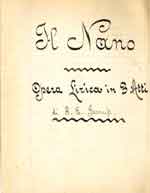
Gus wrote an Italian
libretto titled Il nano
(The Dwarf), possibly in
1870 [2]. This formed the
basis of his later libretto
for
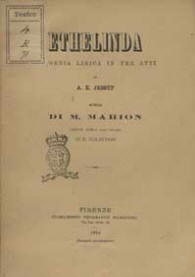
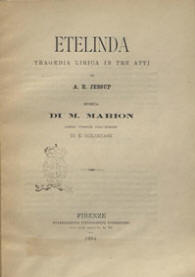
Ethelinda/Etelinda (1894)
[3,4].
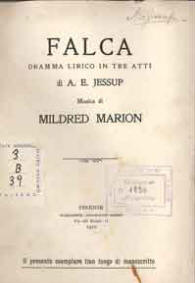
He later wrote Falca,
probably in 1894/5 [5].
Both were set to music by
his wife, Mildred, but only the music for the former seems to be
extant [6]. He published at least two scientific papers
with his son, Alfred, and others[7] and privately printed a volume of
poetry in the early 1900s entitled The Threshing Floor
and other poems (Leipzig: C.G. Röder, 1907), some
poems from which were later published by David
Nutt in London in 1908 under the title Sir
Christopher. In 1921, he
privately published a volume titled Sir Christopher and
other poems (Perugia: Unione Tipografica Cooperative,
1921) and a play, King Dagrun (Perugia: Unione
Tipografica Cooperative, 1921). The latter leant heavily
on the Il nano/Ethelinda plot and sometimes
used the actual
text. Interestingly in the light of Munday's
reminiscences above, Gus
prefaced it "This play is
written for the study; if
acted, the dialogue must be
freely cut".
|
Some sources, including the British
Library, call him Alfred.
The confusion might be
because both his father and
son were named Alfred.
Books, articles, online
David Watt. Augustus Edward Jessup
(Bicester, 1999). Loose-leaf typescript in Glamis Castle
Archives that gives his history as well as
shorter accounts of his three wives, children and a few other
close relatives.
Russell Burdekin, "The
Lady of the Winding Stair". Opera. Vo. 72. No. 9 (Sept
2021), pp. 1114-1120. This has now been expanded and
full references added,
see
Lady Mildred Jessup's Etelinda (Ethelinda).
|